Co-Intelligence by Ethan Mollick
The BookClub read, January 2025

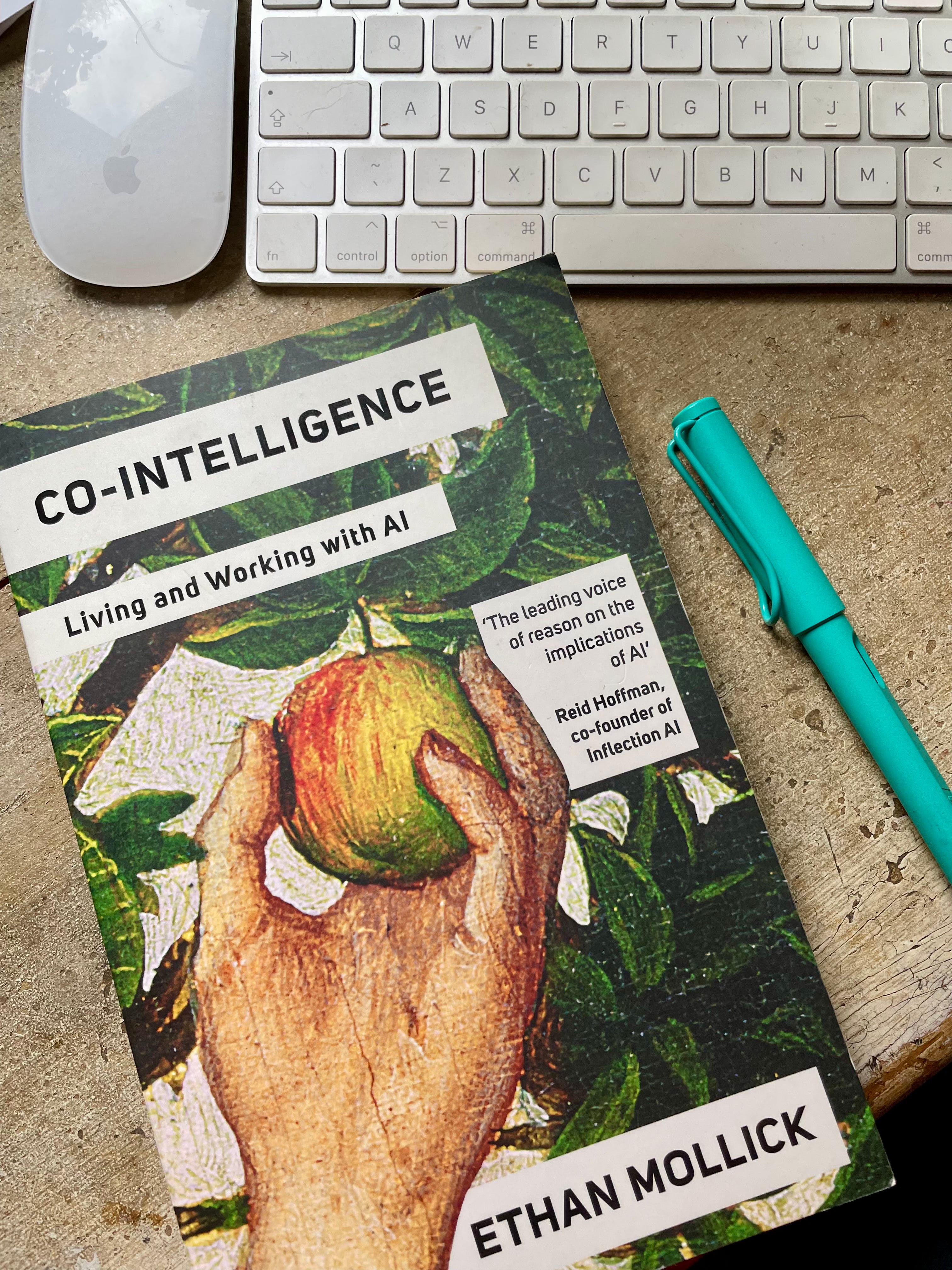
AI. If you aren’t using it, experimenting with it, working with it daily then you’re being left behind. Mollick knows this firsthand, I follow his daily LinkedIn posts where he experiments with AI and documents his discoveries, providing a real-time window into AI's rapid evolution.
The book is an excellent introduction to AI and the different ways you can incorporate it into your daily work. The “how” is the major sell on this book and I’ve recommended it to many of my friends who have confided in me that it all seems a little overwhelming. If you are feeling this, start here. It’s an easy and fast read at about 200 pages.
He starts with some rules of the game.
Always invite AI to the table (exploring what this means around data privacy, dependency risk, erosion of judgement and also the importance of alignment),
Be the human in the loop (to weed out hallucinations with your critical thinking and human expertise and not simply accepting whatever it serves up),
Treat AI like a person (and tell it what kind of person to be),
Assume this is the worst it will ever be.
These rules are simple and easy to remember and can be applied as AI evolves.
What I particularly like is that Mollick gives AI practical roles it can adopt to help his work. He explores the different options of Person, Coach, Creative, Co-worker and Tutor and asks you to consider what that looks like for you. Two of my favourite explorations were:
Creativity: how it explores how AI can use the power of randomness with a very interesting view of the Alternative Uses Test [1].
Co-worker: discusses how AI can free us up from more menial tasks to allow us space for critical thinking and creativity.
At the end he discusses AI as our future with philosophical discussion points explored that have been raised previously. This quote from Geoffrey Hinton, one of the founding fathers of modern AI, underscores the profound implications of AI that Mollick explores in the book's final chapters “it’s quite conceivable that humanity is a passing phase in the evolution of intelligence”. Quite a sentence.
He ends considering as technology use increases, so should our contemplation of what it means to be human; our purpose and connection.
While Mollick focuses on practical applications, some might notice the absence of discussion around AI's environmental impact. However, the book's primary goal is getting readers comfortable with AI and how to use it, and here it succeeds well.
You learn how to move past fear and into curiosity, exploration and learning. It’s practical and gives great prompts for your prompt play.
I’m looking forward to the BookClub on this one.
[1] Alternative Uses Test: https://en.wikipedia.org/wiki/Guilford%27s_Alternate_Uses